
Press Kit for Podcast Guests That Gets Yeses
 Sam Treminio
•
Sam Treminio
•
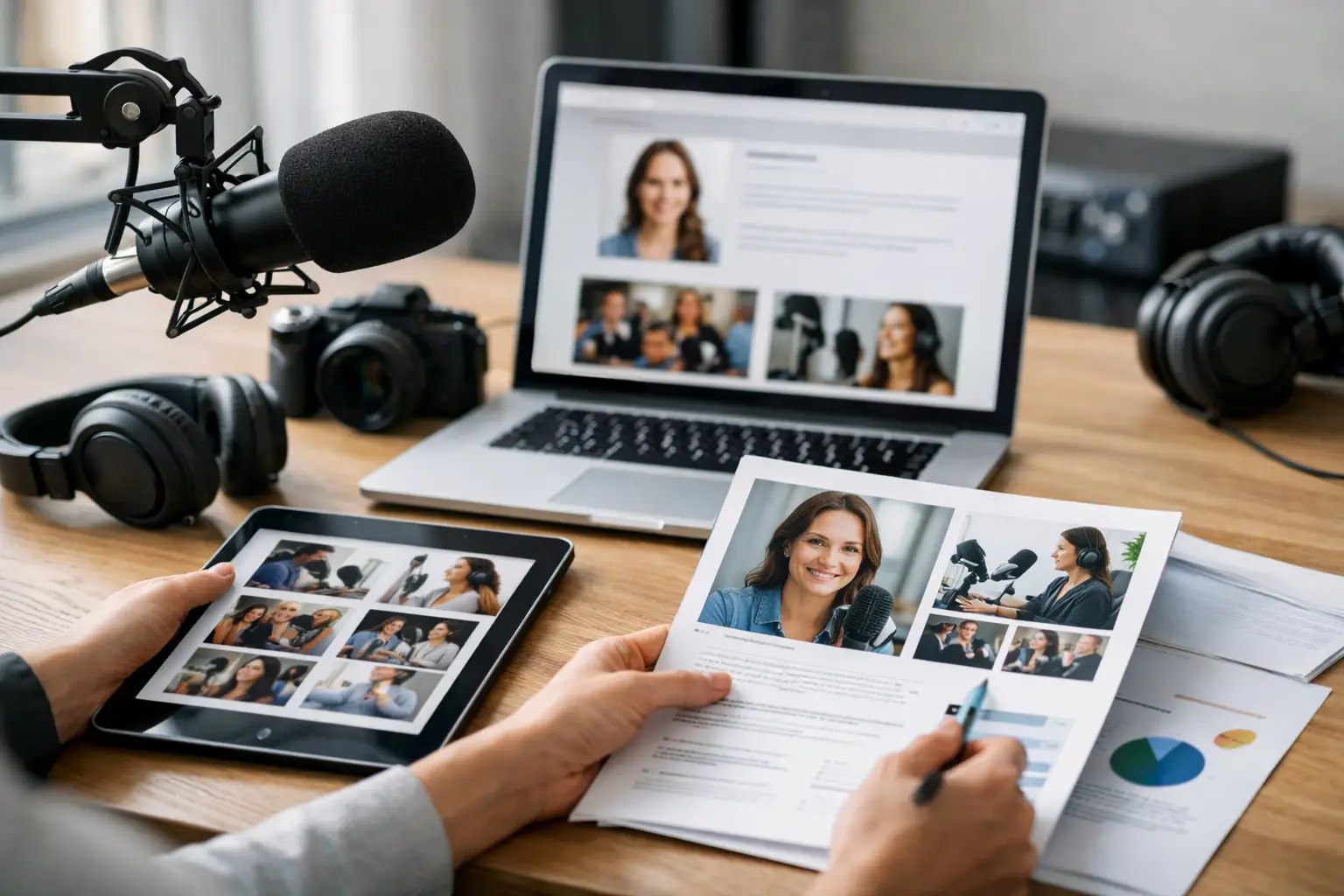
Most podcast hosts make a decision fast. They are scanning for one thing: can this guest make my episode better without creating extra work? A strong press kit for podcast guests answers that question in minutes.
That is why your press kit is not a vanity document. It is a conversion asset. When it is built well, it shortens the host’s decision cycle, strengthens your credibility, and gives producers everything they need to book, prep, and promote you. When it is weak, even a solid pitch can stall.
What a press kit for podcast guests actually does
A podcast host is not hiring you for a keynote. They are evaluating fit, speed, and audience value. Your press kit should make those three things obvious.
Fit means the host can instantly understand who you are, what you talk about, and why their listeners should care. Speed means they do not have to chase your bio, headshot, social links, topic angles, or past appearances. Audience value means your ideas feel specific enough to earn attention, not generic enough to be ignored.
This is where many experts miss the mark. They send a speaker reel, a long media page, or a general company one-sheet and assume it is close enough. It usually is not. A podcast-specific press kit should support booking decisions, not just look polished.
The core elements every podcast guest press kit needs
The best podcast guest press kits are tight, useful, and built for action. They do not try to tell your whole life story. They help a host say yes with confidence.
Start with a short positioning statement. In one or two lines, explain who you are, who you help, and the lens you bring. This should be sharper than a general bio. If you are a founder, say what kind of founder. If you are a consultant, say what problem you solve. If you are an author, explain the angle behind the book, not just the title.
Then include a professional bio in two versions: a short version and a longer version. Hosts and producers use bios in different ways. A 50 to 75 word version is useful for show notes and intros. A 150 to 200 word version gives them more context when they are researching whether you fit the show.
You also need a clear list of talking points or episode topics. This is one of the most important sections in the entire kit. Do not just write broad themes like leadership, mindset, marketing, or growth. Those are too vague to sell. Instead, frame topics as outcomes, tensions, or contrarian insights. A strong topic sounds like a conversation listeners would actually choose.
A good press kit also includes headshots, brand-approved photos, company name and title, website, social handles if relevant, and contact details for the person managing bookings. If you have notable media appearances, podcast interviews, or authority markers, include them selectively. Selectively matters. Ten strong credibility signals beat a cluttered wall of logos every time.
What hosts want to see before they book you
Hosts are looking for proof, but not always the kind guests expect. They are not only asking whether you are accomplished. They are asking whether you are interview-ready.
That means your press kit should show signs that you can communicate clearly and hold attention. Past podcast appearances help. Strong topic framing helps more. A concise quote or short personal hook can also work if it gives the host confidence that you have a point of view.
What they do not want is friction. If your materials are hard to scan, overly branded, full of jargon, or written like a corporate brochure, you create doubt. Busy hosts do not want to decode your expertise. They want to understand it quickly and imagine a good episode immediately.
This is especially true for founders, physicians, consultants, and B2B experts. You may know your field deeply, but deep expertise does not automatically translate into a strong guest profile. The press kit has to bridge that gap.
How to make your press kit sound bookable, not self-promotional
The fastest way to weaken your kit is to make it all about you. The host is not looking for your greatest hits album. They are looking for audience payoff.
So write from the listener’s perspective. Instead of saying you have 20 years of experience, show what that experience allows you to explain clearly. Instead of saying you are passionate about innovation, explain the specific shift you see in your market and why listeners should care now.
This is a subtle but critical difference. A self-promotional press kit says, here is why I am impressive. A bookable one says, here is why this episode will be worth your audience’s time.
That does not mean you should downplay authority. It means your credibility should support the value proposition, not replace it. Titles, results, books, exits, awards, and client wins all matter. They just matter most when tied to a conversation angle.
Common mistakes that cost guests bookings
The biggest mistake is sending generic materials. If your press kit looks like it was built for conferences, PR, investors, and podcasts all at once, it probably serves none of them well.
Another common mistake is including topics that are too broad. Hosts need specificity. “How to grow your business” is weak. “Why founder-led content outperforms brand content in crowded B2B markets” is stronger because it gives shape to the conversation.
Poor visuals can also hurt. You do not need a luxury photoshoot, but you do need clean, current, professional images. Grainy photos, outdated branding, or inconsistent titles create questions you do not want.
Then there is overkill. Long bios, dense paragraphs, too many links, too many logos, and too many topic options can bury the good stuff. More information is not always more persuasive. Often it is just more work for the host.
Finally, many guests forget alignment. A polished press kit does not guarantee bookings if the positioning is off for the shows being pitched. The strongest kits are built with audience fit in mind. That is where strategy matters.
How to build a press kit for podcast guests that converts
Start by getting brutally clear on your podcast angle. Not your credentials. Not your service list. Your angle. What do you want to be booked to talk about, and why is that conversation timely, useful, or different?
Next, write your positioning statement and bios around that angle. Then build five to seven strong topic ideas that feel distinct from one another. If every topic sounds like a variation of the same talking point, you are not giving hosts enough range.
From there, organize your visual assets and proof points. Include one or two headshots, your title, company, relevant brand mentions, prior interviews if they help, and any approved descriptions a producer could drop into a booking workflow without editing from scratch.
Then test it against a simple standard: if a host saw only this document, would they understand who you are, what kind of episode you would deliver, and why their audience would benefit? If the answer is not obvious, tighten it.
It also helps to remember that different shows care about different things. Some hosts want tactical frameworks. Others want founder stories. Others want strong opinions. Your press kit should be clear enough to establish your lane, but flexible enough to support multiple relevant show formats.
Why a great press kit still needs smart outreach
A strong press kit improves your odds. It does not replace strategic pitching.
This is where a lot of experts waste time. They assume good assets alone will create demand. In reality, bookings usually come from the combination of sharp positioning, targeted show selection, strong outreach, and clean follow-through.
That is also why done-for-you support can change the game. When your press kit is paired with the right podcast targets and custom messaging, it stops being a passive file and starts becoming a real booking tool. Podcast Cola builds press materials with that end use in mind, because the point is not to own a nice-looking document. The point is to get booked and get results.
When to update your press kit
Your press kit should evolve as your authority grows. If you have a new book, a stronger title, better media wins, fresh headshots, or sharper topic angles, update it. If your business has shifted direction, update it faster.
A stale press kit sends the wrong signal. It suggests your positioning is static, even if your market relevance is rising. On the other hand, you do not need to rewrite it every month. If the message is clear and the assets are current, consistency is better than constant tinkering.
The right press kit creates momentum because it makes the host’s job easier and your value easier to trust. That is the standard. If your current materials do not do that, they are not supporting your visibility – they are slowing it down.
The smartest move is to treat your press kit like part of your sales infrastructure, because that is exactly what it is. Every great interview starts long before the mic is on.


