
Podcast Interview Prep Checklist That Wins
 Sam Treminio
•
Sam Treminio
•
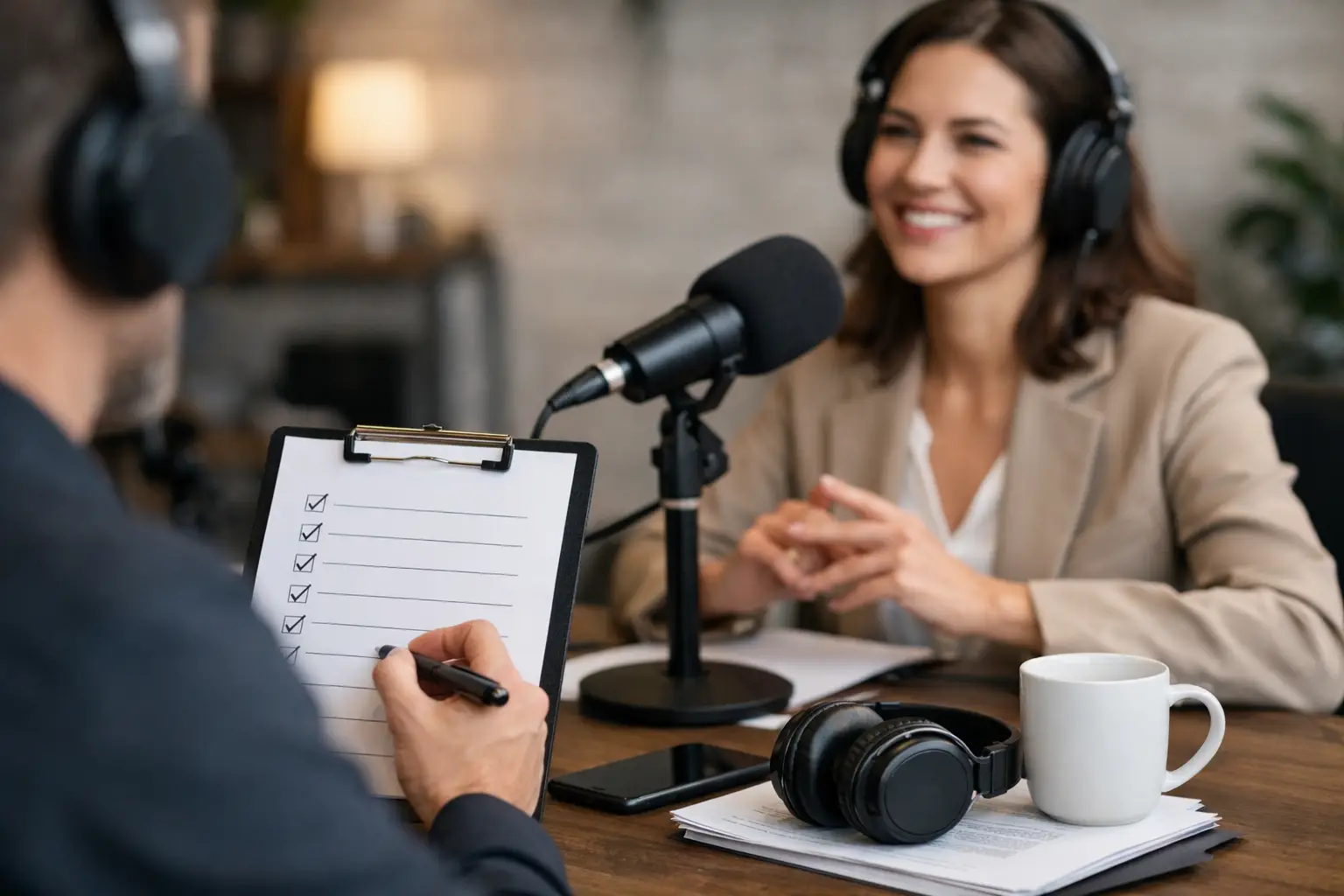
A mediocre podcast appearance usually does not fail because the guest lacks expertise. It fails because the guest shows up with loose talking points, weak stories, and no plan for what should happen after the mic turns off. A strong podcast interview prep checklist fixes that fast. If you want each interview to build authority, attract the right audience, and create real business momentum, preparation is not optional.
Podcast interviews are one of the few marketing channels where trust can compound in real time. A host gives you borrowed credibility. An audience gives you 30 to 60 minutes of attention. That is rare. Waste it, and you sound like every other expert making the rounds. Prepare properly, and you become the guest people remember, search for, and refer.
Why a podcast interview prep checklist matters
Most high-level founders, authors, and service-based experts do not need help having opinions. They need help delivering those opinions in a format that works on audio. Podcasting rewards clarity, pace, story selection, and relevance. It does not reward rambling, jargon, or a self-important bio.
Good preparation gives you control without making you sound scripted. That balance matters. If you over-prepare, you can sound stiff. If you under-prepare, you drift, repeat yourself, and miss the host’s best openings. The goal is not to memorize answers. The goal is to know exactly what themes, stories, and outcomes you want the interview to carry.
This is where serious operators separate themselves. They do not treat podcast appearances as casual conversations. They treat them as authority assets.
The podcast interview prep checklist before you go live
Start with the show itself. If you do not understand the audience, you cannot deliver relevant value. Look at recent episode titles, guest types, and the host’s style. Some hosts want tactical answers and fast pacing. Others want founder stories, deeper reflection, or contrarian takes. You do not need to study 20 episodes. You do need enough context to avoid sounding generic.
Next, get clear on your business goal for the interview. That does not mean turning the episode into a pitch. It means knowing what result you want this appearance to support. Maybe you want more consulting leads, more demand for keynote speaking, more interest in your book, or stronger brand authority in a specific niche. That goal should shape what examples you choose and what themes you reinforce.
Your intro also deserves attention. Hosts often read a bio exactly as received, and most bios are too long, too formal, and too boring for audio. Tighten yours into a few lines that establish credibility quickly. Focus on what makes you relevant to this audience now. Long career history is usually a drag unless it directly supports the topic.
Then build your talking points. Three to five core ideas are enough. More than that, and you risk sounding scattered. Each idea should be simple enough to say clearly and strong enough to stand on its own. If one listener only catches ten minutes of the episode, what do you want them to remember? That is a better filter than asking what sounds impressive.
Stories are where most great interviews are won. Prepare two or three that prove your points. Specificity beats polish. Give the host and audience something concrete: what happened, what changed, what lesson came out of it. A short client story, a business mistake, a hard pivot, or a surprising data point can do more for your authority than a dozen abstract insights.
You should also decide what not to say. This matters more than many guests realize. If there are legal boundaries, client confidentiality concerns, controversial topics that do not serve the audience, or rabbit holes that waste time, mark them in advance. Preparation is not just about adding stronger material. It is also about removing risk.
What to prepare for the actual conversation
A great interview is not a TED Talk. It is a conversation with structure. That means you need to prepare for flow, not just content.
Start by practicing concise answers. Not short because you have nothing to say, but compact enough to leave room for follow-up questions. Many smart guests sabotage themselves by answering the first question for seven straight minutes. That kills momentum. Better to give a sharp answer, pause, and let the host pull more out of you.
Work on your transitions too. Podcast hosts often jump between personal story, strategy, and opinion. If you can move cleanly from one to the other, you sound more natural and more media-ready. Phrases like “what that looked like in practice” or “the bigger lesson there” help you guide the listener without sounding rehearsed.
It also helps to prepare for obvious questions you would rather not fumble. Why did you start the business? What mistake taught you the most? What are people getting wrong in your industry? What should someone do first? These are common for a reason. They reveal how clearly you think.
At the same time, leave room for surprise. The best podcast moments are often unscripted. If you prepare every line, you flatten your personality. You want command of the material, not a memorized performance.
Technical prep is part of the checklist
Strong content can still be undermined by bad audio. If you sound distant, noisy, or unstable, the audience notices immediately. A decent external microphone, wired headphones, and a quiet room are the baseline. You do not need a studio. You do need to sound like someone worth listening to.
Test your setup before the recording day. Check mic input, internet stability, recording platform access, and camera framing if video clips will be repurposed. Put your phone on silent. Shut down notifications. Close extra browser tabs. Small distractions create sloppy energy, and sloppy energy comes through.
Your environment matters more than people think. Hard rooms create echo. Bright windows can ruin video. Household noise can interrupt a strong moment. Handle the basics so you are not trying to fix production issues with five minutes to spare.
How to sound credible without sounding over-rehearsed
The strongest podcast guests are not always the most polished. They are the most clear. They know their point of view. They answer directly. They avoid bloated language. And they are generous with useful detail.
That means cutting filler from your speech. Long setups, repeated phrases, and vague claims weaken your authority. If you say you helped clients grow, quantify it when possible. If you say a strategy works, explain why. Confidence comes from precision.
You should also match the host’s energy without mimicking it. If the show is conversational, loosen up. If the host is highly tactical, get to the point faster. There is always a trade-off here. Too much adaptation can make you feel inauthentic. Too little can make you sound disconnected from the room. The right move is usually somewhere in the middle.
Don’t waste the call to action
A weak close is one of the biggest missed opportunities in podcast guesting. Many experts finish strong, then mumble a vague invitation to “find me online.” That is not enough.
Know your call to action before the interview starts. It should fit the audience and the stage of awareness. A founder speaking to other operators might point people toward a clear service or resource. An author may want listeners to get the book. A speaker may want event organizers to reach out. Pick one primary next step, not five.
Keep it easy to remember and easy to say. If the host asks where people can find you, answer in a way that sounds clean on audio. This is not the moment for complexity.
After the interview, the checklist is not over
If the interview went well, that is the beginning of the asset, not the end. Ask when the episode will go live. Confirm how the show handles promotion. Save the host’s details. A strong relationship can lead to referrals, introductions, or future invitations.
When the episode publishes, promote it with intention. Pull out one or two standout ideas, a quote, or a short clip if available. The goal is not to post a generic “I was on this podcast” update and move on. The goal is to extend the life of the appearance.
This is also where a done-for-you system becomes valuable. Teams like Podcast Cola understand that booking the interview is only part of the result. The bigger win is making sure the appearance supports visibility, authority, and pipeline instead of becoming just another forgotten media hit.
A simple standard for every appearance
Before any interview, ask one hard question: if this episode reaches the exact right listener, will they remember what I stand for and know what to do next? If the answer is fuzzy, your prep is not done.
A podcast interview does not need to be perfect to produce results. It needs to be clear, relevant, and intentional. Show up that way often enough, and your voice starts doing what great visibility should do – building trust before the sales conversation ever begins.


